
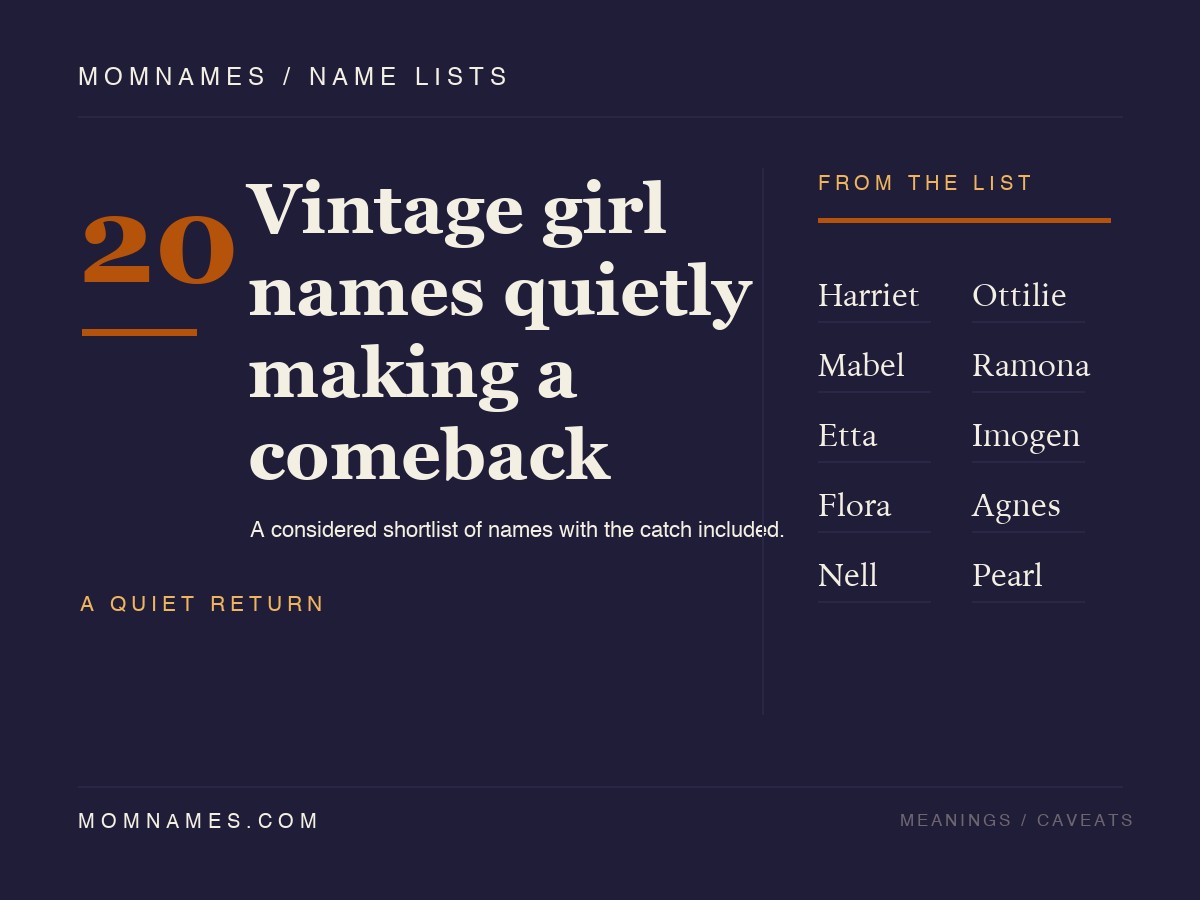
Vintage girl names quietly making a comeback
The vintage girl names quietly making a comeback right now are Harriet, Mabel, Etta and Nell — and twenty of them are below, each with the catch that most name lists leave out. They read as “grandma” in 2005 and now read as the most interesting thing on a nursery list: names everyone recognises but nobody is using yet. That’s a genuinely useful place to be — not so obscure that it feels like a stunt, not so common that it’s the third one in her class.
What most vintage lists get wrong is that they hand you the prettiest old names without telling you the catch. Every name here carries one — a spelling problem, a sudden peak, a pronunciation that will get mangled at every doctor’s office. I’d rather tell you the catch first, because that’s the information that actually changes your decision.
A note on data: meanings and origins below are checked against published sources (including Behind the Name and the Social Security Administration’s name records for popularity). I’ve kept the popularity notes at trend level rather than quoting precise rankings, because a number that’s right this year is wrong next year — and a wrong number is worse than no number. Naming is subjective, and I take a side on each of these. Here’s the list.
The list

Home ruler · English form of Harry/Heinrich.
Pronounced HAIR-ee-ett, stress on the first syllable. It’s a strong, bookish name that’s been quietly rising for years. Caveat: it can read a little severe, and the Harriett spelling is out there. Style note: pairs beautifully with a floral middle name.
Lovable · from Amabel.
The comeback story of the group — Mabel is unmistakably vintage and somehow still sounds fresh. Caveat: expect the “Mae-bull” misreading to continue into adulthood. Style note: short, warm, impossible to shorten further, which is a virtue.
Blessed peacemaking · Welsh Gwenfrewi.
Winnie gives you the soft everyday name while Winifred carries the weight. Caveat: a lot of name for a child who might prefer to be just Winnie. Style note: pairs with a one-syllable middle name.
Short form of Henrietta and other names ending in -etta.
Pronounced ET-uh. It started as a nickname, not a standalone name — that’s part of why it feels so friendly. Caveat: it’s trending hard, so it’s already the “everyone picked it” name in some circles. Style note: makes a sharp first name with an old-fashioned middle.
God is my oath · Scottish diminutive of Elspeth/Elizabeth.
Sweet without being saccharine. Caveat: some adults find it reads younger than it is, which may matter more later than now. Style note: Elsie and one longer middle name balance well.
Flower · Roman goddess of spring.
Light, feminine, and the least “period piece” of the group. Caveat: it can feel delicate next to a strong surname. Style note: Flora pairs with almost anything.
Gemstone.
A one-syllable name with real presence. Caveat: the “purl” knitting homophone gets jokes at school. Style note: strong as a middle name if it’s too bold as a first.
Companion, friend · Hebrew.
Quietly one of the most solid names on this list. Caveat: it’s been used steadily, so it won’t feel novel — it’ll feel classic, which is its own thing. Style note: Ruth holds up at every age.
Medieval diminutive of Eleanor, Ellen or Helen — possibly from “mine El” becoming “my Nel”.
Pronounced NELL. A soft, contained name that reads modern despite being ancient. Caveat: short names get typos in surprising ways (“Nell” becomes “Nellie” on forms). Style note: pairs with a grander middle name.
Prosperous in battle · German.
The name people hear once and fall for. Caveat: the spelling gets mangled (Ottilie vs Ottilia vs Odile), and it reads intellectual in a way some people don’t want. Style note: worth the spelling hassle if you love it.
From Danish, via Latin Marina — “of the sea”. Not, as often assumed, a form of Mary.
Pronounced MAHR-en. Crisp, coastal, and gender-neutral-leaning without losing its polish. Caveat: people will ask “Maren or Marin?” on the phone. Style note: strong first name, works with a soft middle.
Plant name.
Unassuming and quietly lovely. Caveat: reads slightly bohemian, which is a feature unless it isn’t your vibe. Style note: one of those names that works as either first or middle.
Pure, holy · Greek.
The vintage name that’s genuinely on the way back up. Caveat: the “ag” sound gets some kids teased; give the nicknames (Aggie, Ness) room. Style note: Agnes with a bright, unexpected middle is a great combination.
Gift of God · Greek.
Dottie is adorable; Dorothy is timeless. Caveat: it skews older than some of the others — make sure you’re ready for that. Style note: Dorothy is a workhorse that ages like good leather.
The Spanish feminine of Ramón (Raymond) — “wise protector”.
Pronounced ruh-MOH-nuh. Warm, literary (Beverly Cleary made it famous), and a little bohemian. Caveat: three syllables gives it more “name” than some want. Style note: Ramona pairs with a crisp one-syllable middle.
Lily · Hebrew.
The longer, more elegant form of Susan. Caveat: everyone will spell it Susan or Suzanna first. Style note: Susannah is generous with nicknames (Sue, Suzie, Sanna).
White · French.
Short, dignified, and almost untouched in recent years. Caveat: the “Golden Girls” association is real, though younger readers won’t have it. Style note: Blanche with a modern middle name is a striking contrast.
Probably from Gaelic inghean, “maiden” — though it may have started as a misreading of Innogen in Shakespeare.
Pronounced IM-oh-jen (not IM-uh-jen). Artistic, literary, quietly distinctive. Caveat: the pronunciation is nearly always corrected once. Style note: pairs with a simple, grounded middle name.
Gazelle · Aramaic.
Fresh, feminine, and underused — Tabitha never got the revival it deserved. Caveat: the “Tabby” shortening is cute on a child and less cute on a résumé. Style note: Tabitha is substantial enough to carry a short middle name.
Hebrew — the meaning is genuinely debated: “bitter”, “beloved” or “rebellious”; the sources don’t agree.
The biblical sister of Moses, and a name with real depth. Caveat: it’s a lot of name; the Mir/Mim short forms soften it. Style note: Miriam balances a modern, punchy middle name perfectly.
How to pair these with middle names

The trick with vintage names is that they’re almost all “three-or-more syllables” and they almost all carry weight. So the strongest combinations put a vintage first name with a shorter, modern middle name — Harriet Mae, Elsie June, Ramona Rae. I’m going to disagree with half of my own advice here: that formula only works when the middle is unexpected. Harriet Rae has a snap to it; Harriet Rose is a cliché with extra steps. The pairings that actually land are the ones with a texture contrast — a soft first name with a blunt middle, or a long name with a sharp one.
Avoid two vintage names stacked together unless you’re deliberately going for an heirloom effect — Harriet Blanche reads like a nineteenth-century census line, and that’s only charming in fiction.
Who this doesn’t suit

If you want a name nobody has to spell, pronounce, or explain, most of this list will frustrate you. Etta and Elsie are safe enough; Ottilie, Ramona, and Susannah come with a lifetime of small corrections. If you dislike being asked “is that a family name?” — a question every one of these will draw — these may not be for you. And if you want a name that reads brand-new, several of these (Pearl, Ruth, Agnes) are already climbing, so they’ll feel familiar within a couple of years.
For the record, the three I’d actually use from this list are Etta, Flora and Nell — they sound like people, not costumes. And the one I’d talk someone out of is Ottilie: it’s beautiful on paper, but a lifetime of “how do you spell that?” is a real tax, and I’d rather a child spend that energy on anything else.

FAQ
Are vintage girl names popular right now?
Some are climbing fast — Etta, Agnes and Mabel have all risen in the US rankings in recent years, part of a broader vintage revival that shows no sign of stopping. Others like Blanche and Tabitha are still rare enough to feel personal.
Will a vintage name feel dated in ten years?
That’s the honest risk of this category. Names that read “vintage” today can feel “old” again, but the ones with short, lively nicknames (Winnie, Dottie, Aggie) tend to hold up best because the nickname carries the everyday weight.
Is it better to use a vintage name as a middle name?
It’s a great middle-name pool precisely because these names are substantial. If the full vintage feel is too much for a first name, they make distinctive middles that don’t clutter a child’s daily life.
Which vintage names avoid spelling problems?
Pearl, Ruth, Fern, and Flora are the spelling-safest on this list. Nell and Maren get phone-spelled, and Ottilie and Susannah are near-certain corrections.
What’s the fastest way to check how popular a name is?
The US Social Security Administration publishes free annual rankings at ssa.gov. That’s the authoritative source, and it’s worth ten minutes before you commit to a name.
