
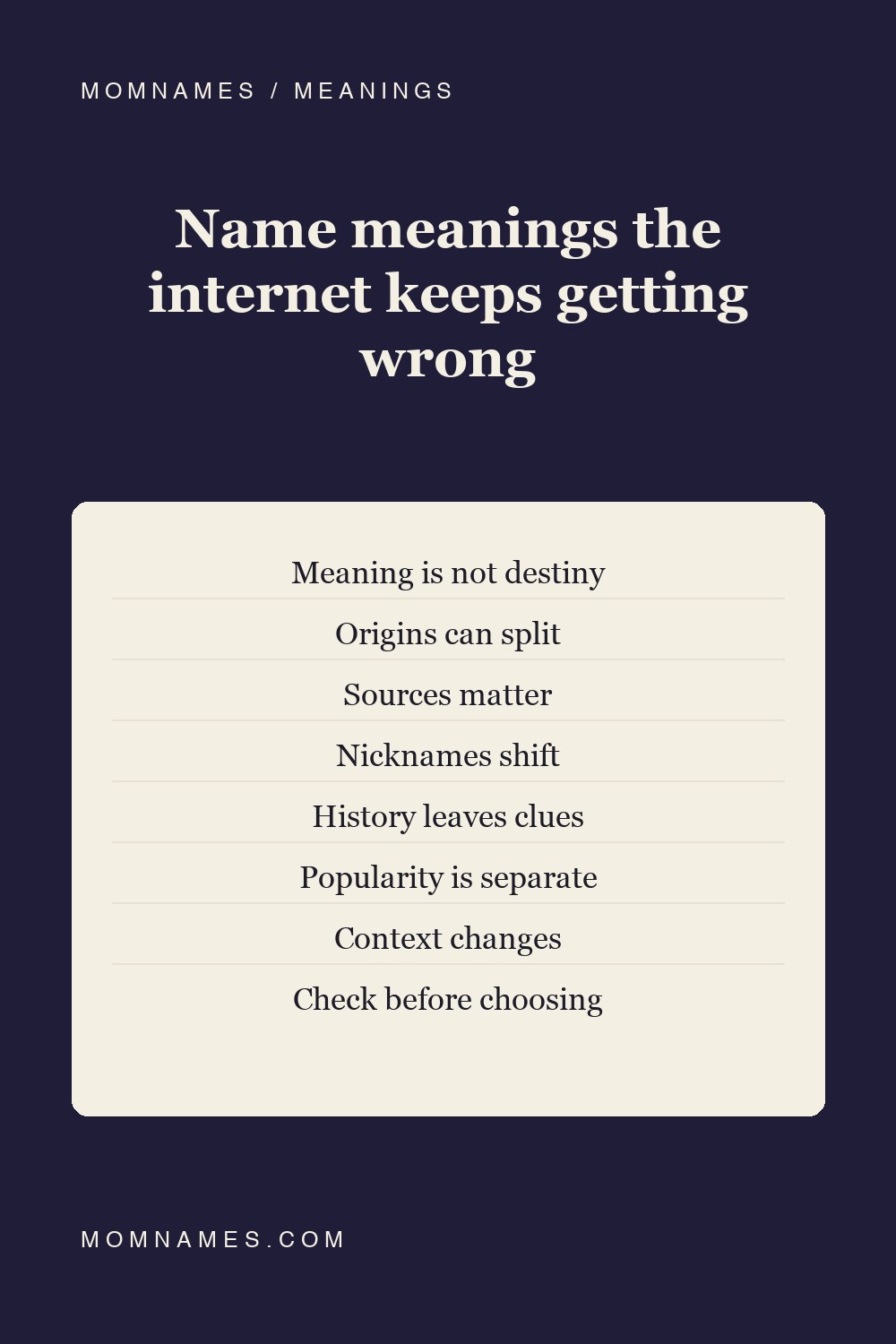
Name meanings the internet keeps getting wrong
Most of the name meanings you read online are unreliable, and for three specific reasons: they’re copied between sites without a single source, they flatten genuinely disputed etymologies into one tidy answer, and a surprising number are simply invented. The meaning of a name is a fact with a source, not a vibe — and once you know how to spot a made-up meaning, the fake ones are easy to catch.
Here’s how the name-meaning industry actually works. A huge share of “baby name meaning” pages exist to catch search traffic and show ads, and they build their content by paraphrasing each other. Nobody in that chain is checking a real etymological source, so an error introduced once gets copied a thousand times until it looks like consensus. The confident tone is the product; the accuracy is optional.

Tell one: a single, tidy meaning with no source
Real etymologies are frequently messy. A name may descend from an uncertain root, or scholars may genuinely disagree — and an honest source says so. When a site hands you one confident, poetic meaning with no citation and no hint of doubt, that certainty is itself the warning sign. The truth is usually “probably X, possibly Y,” and the pretty single answer is often the one someone smoothed over for readability.
A quick example of honest uncertainty: names like Imogen and Miriam have meanings that are genuinely debated between sources. A trustworthy entry tells you that; a content farm picks the prettiest option and states it as fact.
Tell two: the invented meaning
Plenty of modern and invented names don’t have an etymological “meaning” at all — they were coined for their sound, or blended from other names. That doesn’t stop meaning-sites from assigning them one, because a page that says “this name has no traditional meaning” doesn’t rank as well as one that promises a hidden significance. If a very new or clearly invented name comes with an ancient-sounding meaning, be suspicious: someone likely reverse-engineered it.
Tell three: the ancient root the pretty sites hide
The opposite problem is just as common — real meanings that aren’t flattering, quietly swapped for nicer ones. A few genuinely well-documented cases worth knowing: Mallory traces to an Old French word for “unlucky” or “ill-omened,” Cecilia and Cecil come from a Latin root meaning “blind,” and Cameron derives from Gaelic elements traditionally read as “crooked nose.” None of these are reasons to rule a name out — they’re centuries removed from how the name reads today — but a site that scrubs them is choosing marketing over accuracy, and you deserve to make the call yourself.
The surname-as-first-name blur
A whole category of popular names started as surnames, which means their “meaning” is usually an occupation or a patronymic, not poetry. Harper is literally “harp player”; many Mac- and -son names mean “son of” someone. There’s nothing wrong with that, but if a site dresses up a plain occupational surname as something lyrical, it’s telling you what you want to hear rather than what’s true.
How to verify a name’s real meaning
Cross-check any meaning against at least two independent, sourced references rather than trusting a single listicle. A specialist etymology resource that cites its sources and openly flags disputes is worth more than ten confident content farms that all agree with each other — because they all agree by copying, not by checking. If the two sources conflict, that conflict is the real answer, and it’s more honest than either tidy version.
One clarification while we’re here: the Social Security Administration is the authority on a name’s popularity, not its meaning. Its data tells you how many babies got the name and when — invaluable for judging trends — but it says nothing about etymology, so don’t conflate a good popularity source with a good meaning source.
Where this matters less than you think
Here’s my actual position: for most families, a name’s literal etymology should be near the bottom of the decision, not the top. Almost nobody hears “Cecilia” and thinks “blind,” or “Mallory” and thinks “unlucky” — the ancient meaning is invisible in daily life, buried under centuries of the name simply being a name. What matters far more is how it sounds, how it ages, and what it means to you personally.
Where the meaning genuinely counts is at the extremes: a name whose meaning is actively unpleasant and still legible (rare), or a name given specifically to honour a meaning — a virtue name, a name chosen for its translation. In those cases, get it right from a real source. Everywhere else, verify it so you’re not caught out, then let it go and choose on sound.
In the next ten minutes
Take the two or three names on your shortlist and look each one up in two independent, sourced references. Don’t just confirm the pretty meaning — read whether the sources agree, and note any origin the popular sites left out. Ten minutes now saves you from confidently repeating a wrong etymology at every introduction for the next eighteen years.
Keep reading: Vintage girl names quietly making a comeback · Meanings & Origins · Choosing a Name
Sources: Check name origins and disputed meanings against Behind the Name, and verify US popularity trends in the Social Security Administration name database.
FAQ
Why are baby name meanings online so often wrong?
Many name-meaning pages are built for ad traffic and copy each other rather than checking etymological sources, so a single error spreads until it looks like consensus. They also tend to flatten disputed meanings into one tidy answer and occasionally invent meanings for names that don’t have one.
How do I find a name’s real meaning?
Cross-check it against at least two independent references that cite their sources and flag disputes, rather than trusting a single confident listicle. If the sources disagree, that disagreement is the honest answer — real etymologies are often uncertain.
Does the Social Security Administration list name meanings?
No. The SSA is the authority on a name’s popularity and history in the US — how many babies received it and when — but it doesn’t provide etymology. Use it for trends, and use a sourced etymology reference for meanings.
Should a name’s meaning decide which one I pick?
For most families, no — the literal meaning is invisible in daily life and matters far less than sound, aging and personal significance. It matters most when the meaning is both unpleasant and still obvious, or when you’re choosing a name specifically to honour its meaning.
Do all names have a meaning?
No. Many modern or invented names were coined for their sound and have no traditional etymology, even though meaning-sites often assign them one anyway. A name without an ancient meaning isn’t a lesser name — it just hasn’t accumulated one yet.
