
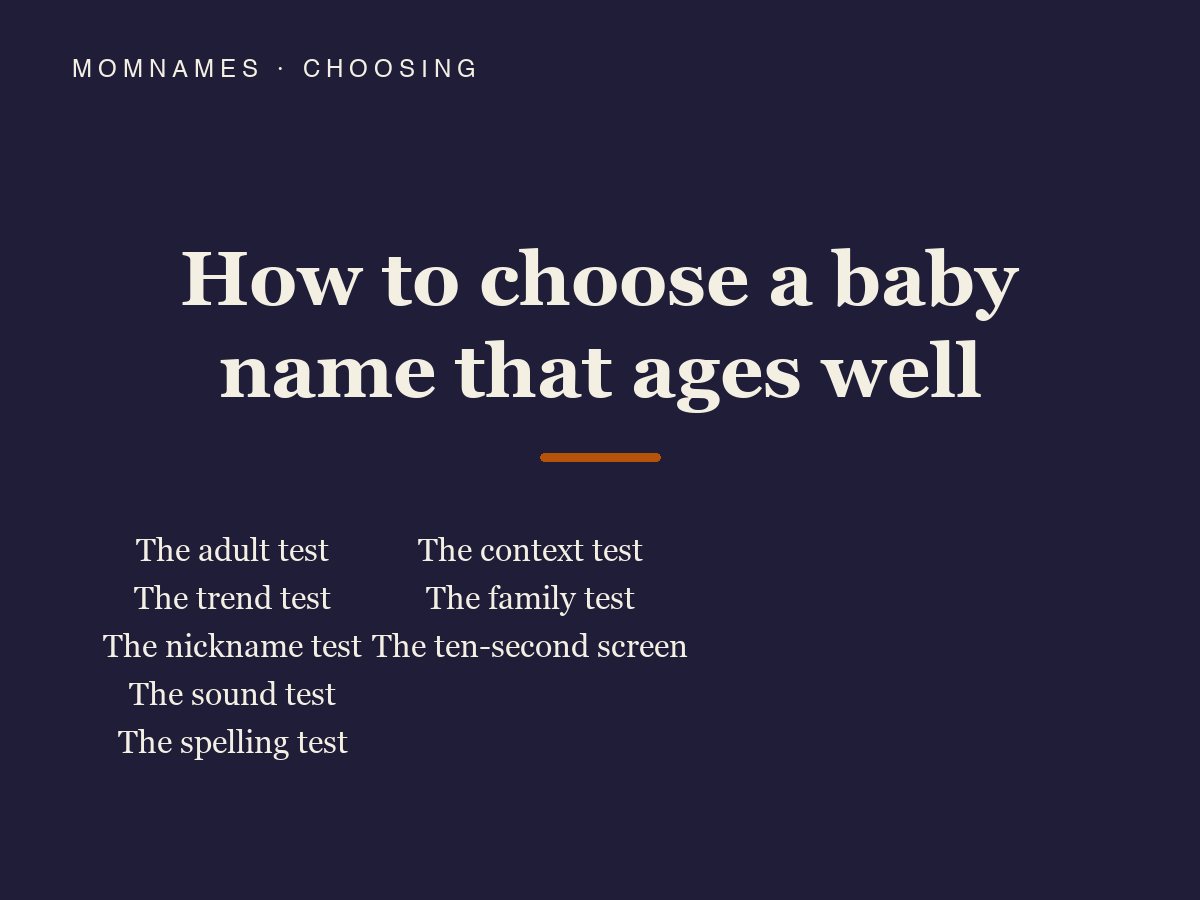
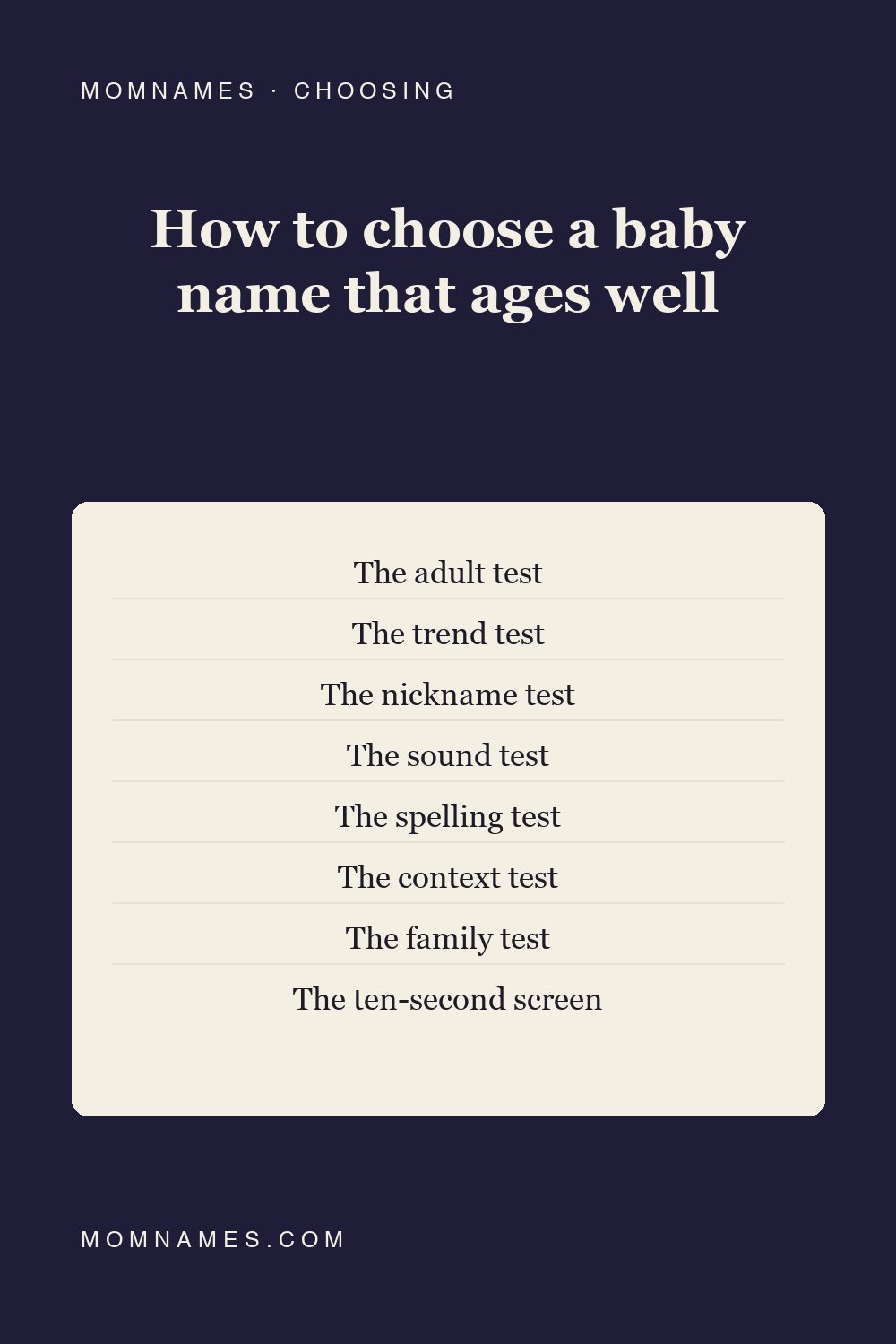
How to choose a baby name that ages well
To choose a baby name that ages well, start with one trait: they already sound right on an adult you respect. Say the name, then imagine it on a 50-year-old surgeon, a kindergartener, and a text from a friend — if it fits all three, it ages well. That’s the whole test, and most name advice skips it because it’s easier to sell you a list than a way of thinking.
You are not naming a baby. You are naming a person who is a baby for about two years and an adult for sixty. The nursery is the shortest phase of that name’s life, and it’s the one every cute-name list optimises for.
Why “timeless” is the wrong target
Chasing a “timeless” name is a trap, because truly timeless names — the Johns and Marys — read as plain to most parents making this decision today. So they reach for something with more character, and the moment a name has character and popularity, it starts to date.
Here’s the honest version nobody says out loud: a name doesn’t age badly because it’s unusual. It ages badly because it was everywhere in one specific window. A name that was #4 the year your child was born will forever read as “born around then,” the way Jennifer reads as the 1970s and Ashley reads as the late 80s. The goal isn’t timeless. The goal is un-pin-able to a year.
The four things that actually date a name
Every dated name got there through at least one of these. Learn to spot them and you can screen any name in about ten seconds.

One: a sharp popularity spike. Not popularity itself — the spike. A name that’s been quietly used for decades wears differently than one that went from nowhere to top-ten in four years. The steep climb is the tell.
Two: a single pop-culture source. Names that arrive attached to one show, one song, or one celebrity baby carry that source like a timestamp. When the source fades, the name doesn’t feel classic — it feels left over.
Three: a trendy sound, not a trendy name. This is the one people miss. Sounds date faster than names. The “-ayden” ending, the “Br-” opening, the “-leigh” spelling — a name can be technically uncommon and still scream a decade because its sound was the trend.
Four: a spelling that was invented to be different. Kaitlyn, Katelynn, Caitlynne — the respellings age worse than the original, because the respelling itself is a fashion. The plainer spelling almost always ages better than the “unique” one.
The test that beats every name list
Do this before you commit to anything. It takes two minutes and it’s more reliable than any popularity chart.
Say the name into a voicemail. Out loud: “Hi, this is [name] calling from —.” If it sounds like a real adult leaving a message, it ages well. If it sounds like a child’s name being read by an adult, that gap will never close; it just gets more awkward.
Then write it on an email signature. [name] followed by a job title. Some names that are lovely spoken look surprisingly slight in print, and print is where the name spends its professional life.
Here’s where I’ll plant a flag: I’d take the distinctive name almost every time. A name shared with three classmates costs a child something quieter but just as real — a low-grade sense of being one of several, of the name never quite being theirs. The spelling tax on a distinctive name is annoying but finite; you learn to spell it once, and then it’s yours for life. The only line I draw is the name so unusual it becomes the child’s entire first impression before they’ve said a word — that’s a heavier tax than any spelling correction. But mild distinctiveness beats safe anonymity, and I’d choose it on purpose.
The nickname escape hatch
The single most reliable way to hedge is a long name with a short, sturdy nickname. It gives the child two names to grow into: the full name for the résumé, the nickname for daily life, and the option to switch as they age.

Theodore becomes Theo or Teddy. Eleanor becomes Nell or Ellie. Benjamin becomes Ben. The formal name ages like a suit; the nickname keeps it warm. And crucially, if the nickname ever dates, the child can quietly drop it and keep the full name — a flexibility a one-syllable name never offers.
The reverse — a short name with no formal version — locks the child in. It’s not wrong, but know that you’re choosing it for life with no exits.
What to do about popularity data
Check it, but read it correctly. The number you want is not “how popular is this name” — it’s “which direction is it moving, and how fast.” A name sitting steadily at #200 for twenty years is a far safer bet than one that rocketed from #400 to #40 in three years, even though the second is technically “less common” at some points.
The US Social Security Administration publishes free annual rankings, and it’s the authoritative source — worth ten minutes before you commit. Look at the shape of the line, not the current position. Flat and mid-list beats steep and climbing, every time, for aging.
Where this advice doesn’t apply
If a name is a family name, none of this matters — inherited names come with meaning that outranks fashion, and a grandmother’s name never reads as “dated,” it reads as “hers.” The same goes for culturally significant names carried across generations. This is a guide for choosing from open field, not for weighing a name that’s already yours by heritage. Don’t let a popularity chart talk you out of a name that means something real.
In the next ten minutes
Take your current front-runner and run only the voicemail test: say it out loud as an adult leaving a message. Don’t research it, don’t poll your family — just listen to whether it sounds like a person or a nursery. That one signal will tell you more than another hour of lists.
If I had to stake a single decision on one idea in this whole guide, it’s the long-name-plus-nickname hedge — it’s the only strategy that hands the child options for life, and options are the entire game. The one I think is overrated is chasing “un-pin-able to a year” too hard: follow it to its logical end and it talks you out of every name with any warmth. A slightly datable name a child loves will always beat a perfectly neutral one nobody feels anything about.
Keep reading: Vintage girl names quietly making a comeback · Choosing a Name · Name Lists
Sources: Check name origins and disputed meanings against Behind the Name, and verify US popularity trends in the Social Security Administration name database.
FAQ
What names age the best?
Names that have been used steadily for decades without a sharp spike, and long names with a sturdy short nickname. The common thread is that you can’t pin them to a single year — they sound equally right on a child and on a professional in their fifties.
How do I know if a name is too trendy?
Look at the shape of its popularity line, not its current rank. A steep recent climb is the warning sign, not popularity itself. A name that’s been quietly mid-list for twenty years ages far better than one that rocketed up in the last three.
Do unique spellings age badly?
Usually, yes. The respelling is itself a fashion, so it dates faster than the standard spelling and adds a lifetime of corrections. If you love a name, the plainer spelling almost always ages better than the “unique” version.
Should I avoid popular names entirely?
No — steady popularity is fine; it’s the sudden spike that dates a name. A name in the 50–200 range that’s been stable for years is a safe, wearable choice. The names to think twice about are the ones climbing fastest right now.
Is it better to name for the baby or the adult?
The adult. The child is a baby for about two years and an adult for sixty, so the name has to carry a grown person’s life. If a name works on someone in their fifties, it will always work on a toddler — the reverse is not true.
